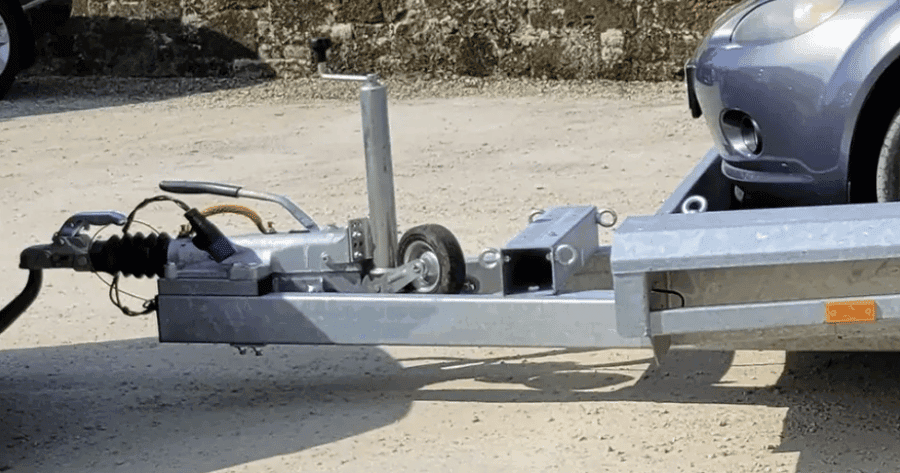

If there’s one thing you don’t want to overlook when towing, it’s your trailer’s braking system. From dampers and handbrakes to breakaway cables, the rules can seem complex - but they’re there for one simple reason: safety.
Let’s break down exactly what the law requires for both braked and unbraked trailers in the UK.
Braked Trailers: The Key Requirements
The rules for braked trailers depend on when the trailer was built, as regulations have evolved over time.
Before October 1982
Braked trailers from this era may use spring-damped couplings as replacement parts.
There’s more flexibility, but older equipment should be maintained carefully and inspected regularly.
After October 1982
All braked trailers must use a hydraulically damped coupling (not spring-damped).
The brakes must comply with EC Directives, meaning all wheels must be braked (if the trailer was built in or after 1968).
The braking system must meet EEC Directive 71/320 (ECE13) for braking efficiency.
After April 1989
Braked trailers must include:
A hydraulically damped coupling, and
Auto-reverse brakes, allowing smooth reversing while maintaining full braking efficiency.
This setup ensures that braking force remains consistent, even when reversing or carrying heavier loads.
Ball Coupling Size
Whether your trailer is braked or unbraked, it must use a 50mm ball coupling that meets ISO and BSI Standards. Older 2-inch couplings are no longer recommended and should be replaced to meet modern safety standards.
Unbraked Trailers: Modern Safety Standards
For unbraked trailers manufactured after 1 January 1997, an additional safety feature is required - the secondary coupling.
This device must:
Provide some residual steering if the trailer becomes uncoupled.
Stop the coupling head from hitting the ground.
Always be connected to the towing vehicle while driving.
If your unbraked trailer doesn’t have one fitted, it’s time to update it - failure to do so could make your setup illegal.
Handbrake & Parking Brake Rules
All braked trailers must have a mechanical parking brake operating on at least two wheels on the same axle.
Key requirements:
It must be purely mechanical - no hydraulics, electrics, or pneumatics.
It should use a rod or cable system.
The handbrake must hold a trailer on a 16% gradient (1 in 6.25) as per EEC Directive 71/320/EEC.
In simple terms, your handbrake must keep the trailer parked securely on a decent hill without slipping.
Breakaway Cable: A Legal Must-Have
All braked trailers must have an emergency breakaway cable connected to the parking brake linkage. This safety cable applies the brakes automatically if the trailer detaches from the towing vehicle, then snaps itself to prevent further damage.
Important points:
The cable should be attached to a dedicated fixing point on the towing vehicle.
Do not loop it around the towball unless there’s no other option.
It’s a separate offence not to use a fitted breakaway cable.
This small cable could make all the difference in preventing a runaway trailer.
Secondary Couplings on Older Trailers
Braked trailers built before 1982 with manual handbrakes should also have a secondary coupling fitted. For newer braked trailers (post-1982) with hydraulic damping, a secondary coupling can still be added, but only if:
It’s suitable for the trailer’s weight, and
It doesn’t interfere with the breakaway cable’s operation.
For heavier trailers (over 1,000 kg), special care must be taken to ensure compatibility.
Brent’s Take
At Brent, we know brakes aren’t the most glamorous part of a trailer - but they’re the most important. Whether you’re towing a car, boat, horsebox, or plant trailer, your braking system is what keeps you, your cargo, and everyone else on the road safe.
Check your couplings, test your brakes, and inspect your breakaway cable before every trip. And if your trailer’s running outdated gear, it might be time for a refresh.
You’ll find modern, compliant, road-ready trailers on Brent - built with the latest safety standards, ready to tow, and always up to spec.
Because when it comes to towing, stopping power matters just as much as horsepower.
-Brent